
 There’s been an interesting flurry of discussions in the past few days, following the news that Regulation Minister David Seymour sought advice on the possibility of removing mandatory cycling helmet requirements. The upshot (for now at least) is that the advice provided to Seymour was that the risks of removing the requirements would outweigh any benefits, and so no further action was taken.
In looking at the details of the advice provided, I have doubts about the validity of some of the analysis. And it certainly rehashes an issue that really hasn’t gone away any time lately here in NZ (particularly when we consider comparisons with places like Europe). So, at risk of poking the bear, I have a few thoughts…
.jpg)
I’m old enough to remember when the NZ helmet law first came into being in Jan 1994. As a young graduate, it took a while to remember to grab my helmet off the wall when setting off to work (handy trick: keep it on your handlebars!). At the time, there was unfortunately no organised national cycling advocacy to push back against the regulation (originally advocated for by the “helmet lady” Rebecca Oaten). It was only later when I got involved with the Cycling Advocates Network (CAN) that the vexed question become a fairly commonly discussed issue (as evidenced by their policy statement on it), but it was too late – the horse had bolted…
Let’s start with a fairly well accepted tenet: IF you fall off your bike and IF your head subsequently hits something solid (be it the ground, a wall, a car, etc), then having a helmet on is likely to reduce the risk of serious head injury, or even death. I only have to consider the example of when my partner came unstuck on some tram tracks a couple of years ago to appreciate that her helmet probably reduced some of the potential damage.
Still, one has to take the numerous stories of how “a helmet saved my life” with a grain of salt, as it’s not always clear what the outcome would have been without a helmet on (the human skull is actually reasonably resilient…) – as the saying goes, the plural of anecdote is not data.
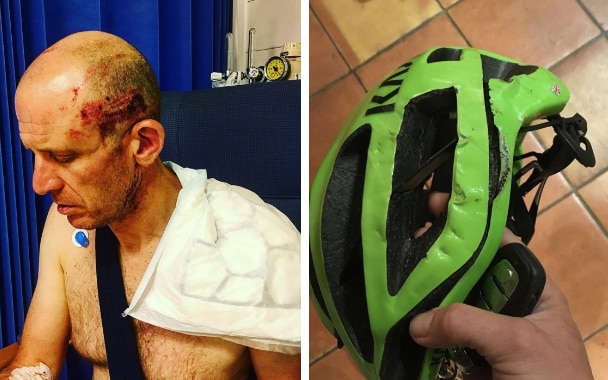
Certainly there’s a fair bit of data around to suggest that wearing a helmet will not always be the panacea to save you. About 12 years ago, in the wake of the Chief Coroner’s cycle safety inquest, I did some investigation of patterns across more than 90 cycling fatalities in NZ. About 89% of riders were wearing a helmet when they were killed (at a time when the national wearing rate was a little over 90%). In most cases, sadly the serious trauma or crushing forces of the vehicle collided with meant that a helmet was not going to help. Even of the ten victims not wearing a helmet, only in one case did the Police report speculate that the helmet may have saved their life.
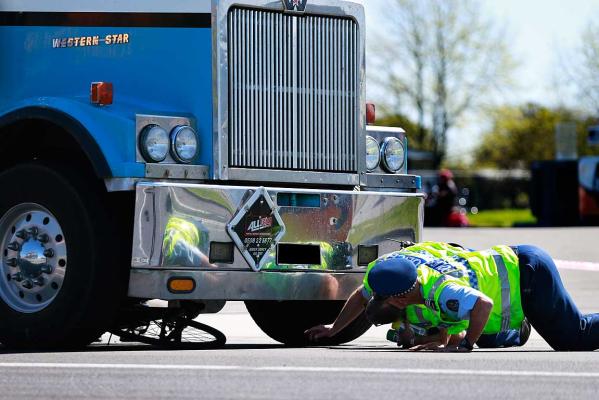
Recently I did another little analysis of cycle injury/fatal crashes since 2016. and the picture appears to be fairly similar. As best as can be discerned from the descriptive info about each crash, it appears that about 90% of people who were injured or killed while riding were wearing a helmet – certainly not notably different from the typical wearing rates even today. Would a reduction in helmet wearing have affected those stats? I’m not sure…
Turning our thoughts away from safety, it’s important to appreciate the health benefits of getting out on your bike as well – which are usually far more beneficial (in terms of life-years gained) than the potential risks of a cycle crash. One of the common stated problems with introducing mandatory helmet laws is that it leads to fewer people wanting to cycle. Certainly we continued to see a notable decline in cycling numbers in NZ after the helmet law was introduced here until we started to roll out better cycling facilities. This is the problem of trying to introduce measures purportedly to improve individual health when the net result becomes a decline in overall population health…

An analogy I like to use in regards to helmet compulsion is this thought experiment: what if instead of just encouraging people to wear a hat/sunscreen when outside in the sun (to reduce the chance of melanomas), we made it compulsory to do so? For context, it’s useful to appreciate that in NZ we have roughly 300 melanoma deaths a year, in comparison to about 10-12 cycling deaths…
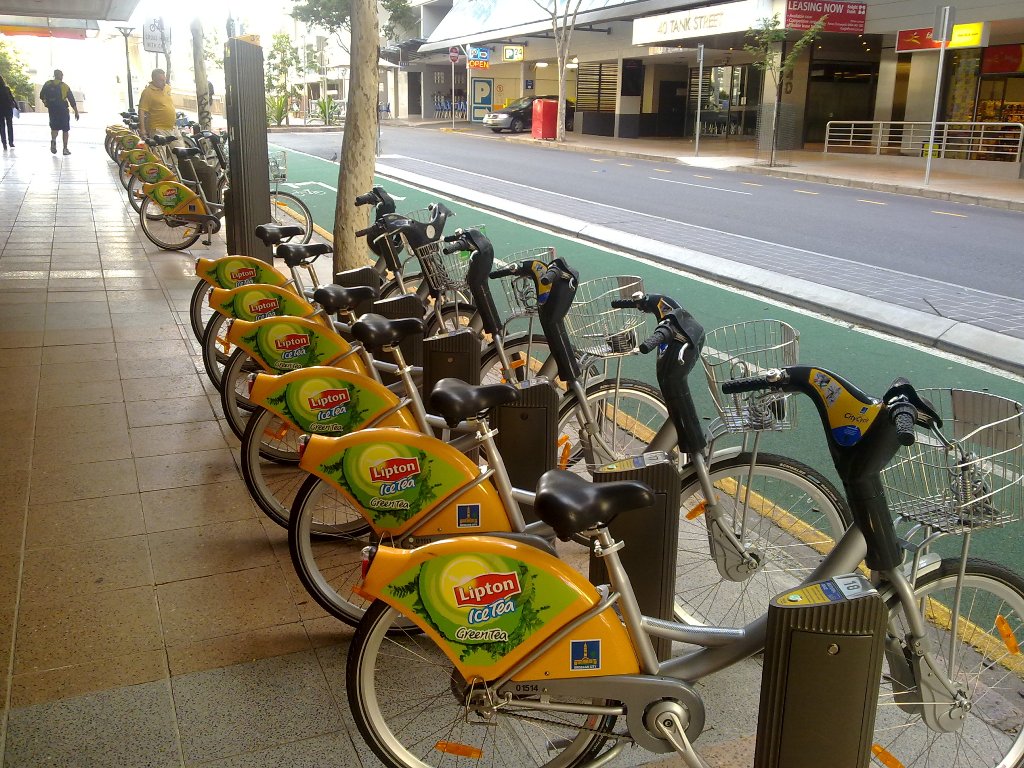
The helmet requirement has also been a bit of an issue when it comes to introducing bike-share schemes – having to also include a helmet as part of each bike (which tend to get nicked pretty soon after anyway…) is a bit of a barrier to people spontaneously hopping on them. It’s no wonder really that Australasia has not adopted public bike-share programmes with great success as a result.
So is there a reasonable halfway house to easing the helmet law? An interesting observation I noticed when I was in Portland US was that Oregon state law only requires children under 16 yrs old to wear a bike helmet. Obviously it’s up to you beyond that age as to whether you want to continue wearing one, but it does mean that parents can encourage their kids to be safe (and if desired, role model the habit by wearing a helmet too). As a starting point to having a mature conversation about cycle safety and helmets, I think it’s not a bad idea…

There are countless other places to investigate this issue further, and it’s certainly not going to be solved overnight. But, particularly as we continue to roll out ever-improving and safer cycling networks, it is worth starting to revisit the ongoing relevance of why we introduced mandatory helmets in the first place…
What do you think about the merits of mandatory bike helmets?
One odd thing about the helmet law is that far more lives would be saved if the law was “reversed “ so that it was compulsory to wear a helmet all the time except on a bike
It might not save your life if you are hit by a motor vehicle, but it might prevent a serious concussion or a traumatic brain injury or lessen the effects of one. It would be interesting to know how many GP or A&E visits are as result of hitting ones head falling off a bike.
I can help answer that question for you via this ACC data enquiry, which found that barely 8% of cycling injury claims involved injuries to the head or neck and no more than 2% of cycling claims resulted in concussion or brain injury – https://www.acc.co.nz/assets/oia-responses/claims-data-for-cycling-related-injuries-gov-006790-response.pdf
It’s interesting to see this issue coming back into the light. I’m also old enough to remember cycling before the helmet law. Spinoff has done an article on it.
https://thespinoff.co.nz/politics/20-08-2025/david-seymour-was-right-to-question-our-compulsory-helmet-laws
Yes, this is too long – both this posting and the lifetime of this heinous rule.
The answer to the question on the “merits”:
• The plastic hat rule is a health, safety, finance, congestion, business, education, human rights, discrimination, et al, disaster.
• It is however a political success, one aided by the lack of effective cycle advocacy.
And yes, there is mountains of papers etc. which underpin the first bullet, as Glen can probably attest. The second bullet is an observation. The first point is of course why the idea, at least 35 years old by now, has NOT spread around the world – indeed when it is brought up by opportunistic politicians in places like the UK the local advocates normally just need to mutter something about AU & NZ and the idea quickly goes away – we are the acknowledged example of what not to do.
Better throw in a quote, one from the UK:
————————————————————————————-
Does the safety risk of cycling outweigh the health benefits?
The answer is, quite clearly, no: the actual risk of cycling is tiny. There is one cyclist death per 33 million kilometres of cycling, while being sedentary presents a much greater risk. Over 50,000 people die in the UK each year due to coronary heart disease related to insufficient physical activity, compared to around 100 cyclists killed on the road. Research suggests that safety risks are outweighed by the health benefits by a factor of around twenty to one.
from Active Travel Strategy, Department of Health & Department for Transport, UK, 2010
————————————————————————————-
(This is of course from long after Rob Storey introduced the NZ rule, but he has acknowledged he knew this, he just had what in modern parlance is called “alternative facts”.)
The benefit of cycling is simply taken as read these days and can be summarised as:
“If a person chooses to ride a bicycle in their normal everyday clothes; no special gloves, hats, shoes or lycra required; then on average across a population they are healthier, live longer and save the rest of society money.”
In New Zealand for providing this good they are ridiculed (“bare head, knuckle head”) and fined (as of 2014 about one person every 30 mins according to Police figures, hopefully less now).
Fining people for doing good is plainly stupid (and wrong if you care about such things). It is also damaging to society in so many ways.
In the early 2000’s the NZ Government noted the benefits other countries were receiving from boosting cycling and wanted NZ to receive some of the same. Here in Christchurch they held a meeting for transport designers and cycle advocates at which there was a surprisingly honest opening statement from the Government reps at the front:
“We shot New Zealand in the foot” with the plastic hat legislation.
They went on to explain that they had intentionally, but erroneously, portrayed cycling as dangerous in order to gain acceptance of the hats. Now they wished to get people onto bikes, a challenge when you’ve spent years claiming it was a dangerous activity, but a challenge they had to meet as it was simply politically too soon to tell the public that the plastic hat promotion has been based on misrepresentation.
That was some 20 years ago, back then the cycling advocates and transport planning professionals (who in Christchurch at that time were often the same people) at the meeting did a collective nothing, they let is pass.
Or as Glen puts it, they let the horse bolt again.
Now after over 30 years, of what we will politely refer to as counter-productive stupidity, David Seymour’s inquiry presents another opportunity for NZ cycling advocates to take a stand and fight for the right to get healthy without ridicule or fine, and provide benefits to society through doing so.
Will they take it, or will the horse be left bolt yet again?
Still here? With such stamina you must be a cyclist! 🙂
If you go and look at the comments of most articles about this one “normal” news sites, people are screaming about how a helmet saved their life. Confirmation bias to be sure, and they are poorly articulated. But it shows that the propaganda absolutely worked.
New Zealand has suffered from mandatory helmet use. Interestingly the stats around death rates on bikes HAS been extensively studied in scores of countries who all were considering bans to helmets. The conclusion in all of those countries? Don’t do it. After seeing the dogs breakfast of ridership in Australia and New Zealand after our laws were implemented they simply didn’t think the costs outweighed the benefits.
Interestingly the majority of cyclists (commuters and short unwalkable journeys) will be doing so in upright city bikes. In an upright position the chance of hitting your head on the ground is low, and the chance your head hits the ground with enough forced to be life changing even lower still. Those who need helmets most are largely competitive cyclists on a track, road cyclists going at high speed, and mountain bikers. Nobody would be caught dead anywhere on a mountain bike trail without a helmet. But the risk of that same bike, when ridden at normal commuting speeds on a regular road, is extremely low.
Would I ever give up my helmet knowing the speed I ride, and the roads I ride on? absolutely not. But grandma Jenkins down the road isn’t cycling at all because a helmet messes up her hair. And she is suffering in terms of micro mobility, and health, for not doing so. Would I love to be able to go to the shops 10 minutes away without having to wear a helmet? yes absolutely, and the chance of an accident there is slim to zero.
Whats really shameful here is that the “bureaucrats” at the ministry of regulation have done a seemingly remarkably poor job of understanding the statistics as the rate of cycling injuries per 100,000 cyclists has actually INCREASED since the 90’s largely because helmet use drove people away from cycling. What we need is more cyclists, and anything we can do to get away from driving cars, and getting into riding bikes, is a good thing.
Concur – there’s more safety in numbers than there is alone and wearing a helmet.