
A few years ago I had an email from a reader (and my apologies that it’s taken this long to respond to it!):
I ride my bike every day in my rounds as a support worker visiting people’s homes here in Christchurch. My colleagues always say “how healthy”, but I am starting to get seriously worried about the exhaust fumes I am inhaling.
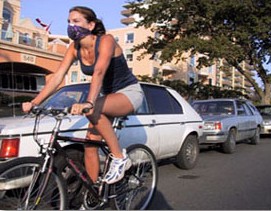
I know that New Zealand imports old (10yrs+) cars from Japan because in Japan they won’t allow them on the roads after a certain date due to foul emissions. Cycling behind these vehicles (or even on the footpath which I use when empty during the day) I can smell these stinking exhausts from all the old tradesperson’s vans, Council worker trucks, trucks idling at kerbs, and yes, young drivers in their first cheap car. After several years of this exposure I now have a tickle in my throat, a slight cough at times, which I have never had in my life before.
It distresses me that in doing something so positive (bike riding) I am impairing my health, but I have never owned a car and I really don’t want to get one now!
Do you have any advice on how to manage this? I think I am going to get some face masks and wear them while riding as they do in Asia. At present I am holding a scarf over my mouth every time a car/van passes.
It’s a good question, and one that I think others wonder about too. Motor vehicles generate a lot of pollution, with far-reaching health effects. In New Zealand, vehicle emissions have been previously blamed for ~400 premature deaths every year, but now more recent estimates have suggested that figure could actually be over 2,000 a year (in Christchurch alone, the numbers are over 300 a year). Many would-be cyclists are put off by the prospect of being exposed to all those traffic fumes, while still others don face-masks when riding (actually quite handy on a chilly morning…). So is it really that bad to cycle in such environments?
The quick answer is yes: if you have the choice between cycling along a remote park path and a busy urban arterial road then the former will definitely be more pleasant and safer on your lungs. Way back in 1991, Michael Bevan et al measured respirable particle concentrations in Southampton (UK) for bicycle commuters. They found that exposure to particles while cycling along a busy city centre street was about nine times higher than when cycling around common parkland. And in 1998 (before he came to Christchurch), Simon Kingham et al had similar findings in Huddersfield (UK), with exposure levels to benzene and particulates about double for cyclists on the road compared with a canal pathway.
(Bear in mind though, that motor vehicle emission standards have improved a lot since then…)
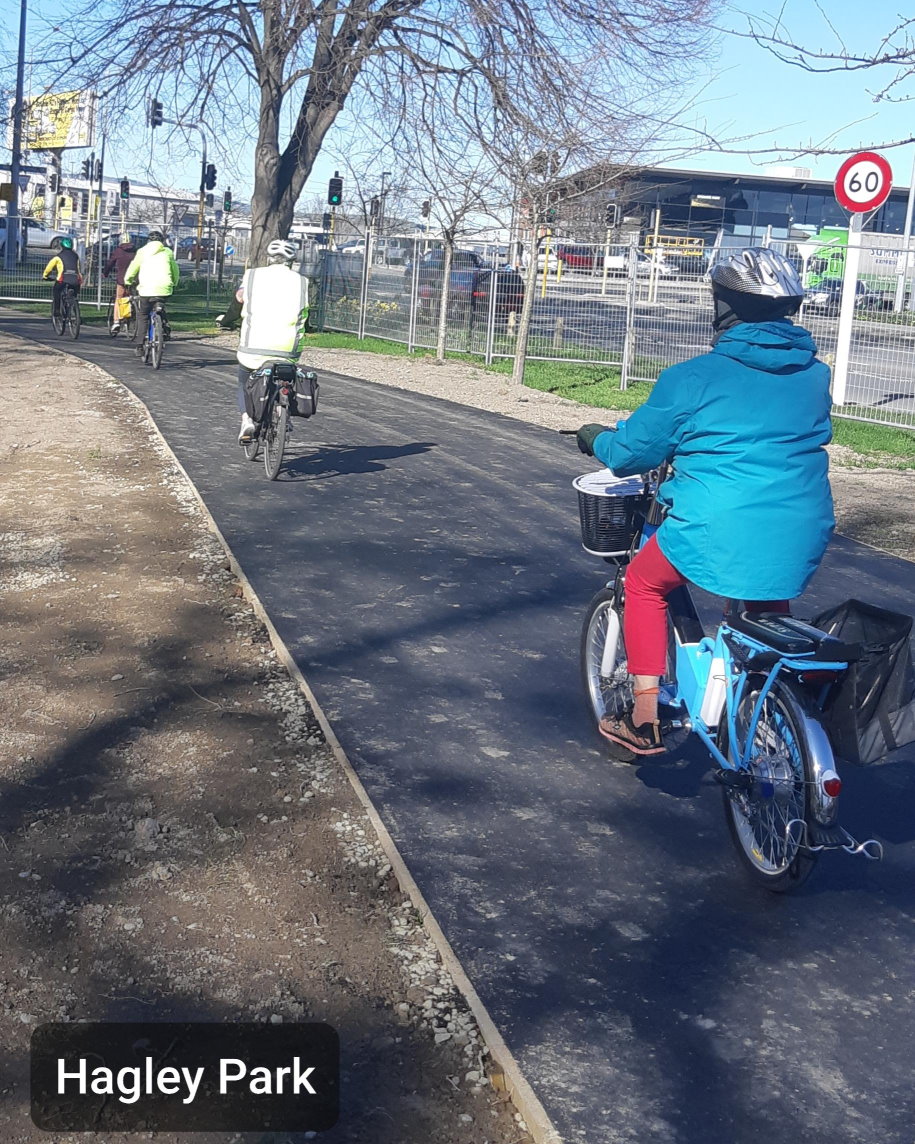
As you might surmise, where exactly you ride in the road corridor will have an effect too. This was demonstrated by some NZTA research in Christchurch back in 2011 by Simon Kingham and other researchers at Canterbury and Auckland Universities and NIWA. The project assessed the comparative risk associated with exposure to traffic pollution when travelling via different transport modes in New Zealand cities. Concentrations of the key traffic-related pollutants were simultaneously monitored on pre-defined routes in Auckland and Christchurch during the morning and evening commute on people travelling by car, bus, on-road bike, and off-road bike.
Three cyclists rode in unison with identical monitoring equipment along a road, an adjacent kerbside footpath (7m away), and an off-road path (19m away in a park) for several hours over five afternoons during autumn in the central city Hagley Park area of Christchurch. They sampled concentrations of ultrafine particles (UFPs), carbon monoxide (CO) and fine particulate matter (PM10).
The research found that cyclists travelling on the footpath behind parked cars had significantly reduced exposure to fine particles and carbon monoxide (about 20-30% lower than on the road). Further reductions in exposure were achieved for cyclists travelling on a parallel path further in the park (about 40–60% lower than on the road).
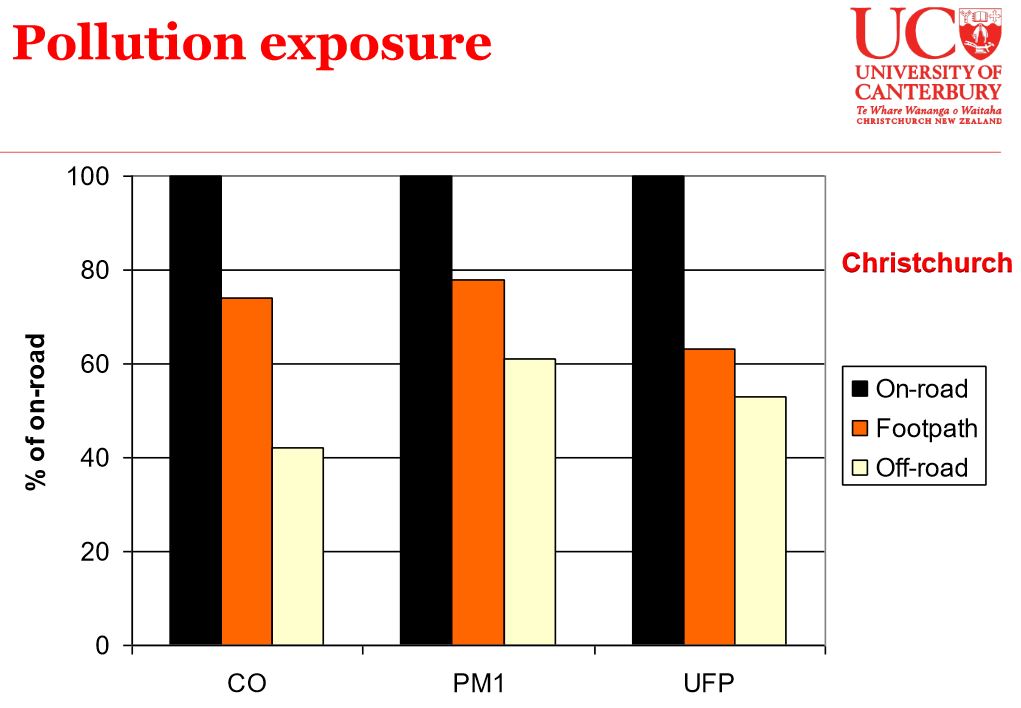
Overall the research found that:
- Car drivers are consistently exposed to the highest average levels of CO.
- On-road cyclists are exposed to higher levels of CO, PM1 and UFPs than off-road cyclists.
- Car drivers and bus passengers are exposed to higher average levels of UFP than cyclists.
- At some parts of their journeys, travellers are exposed to very high levels of pollution, often for short periods of time.
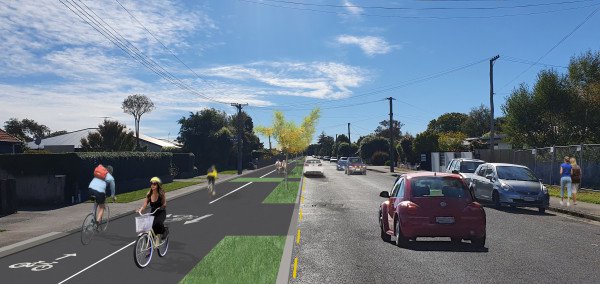
- Locating cycle paths just a short distance from roads can reduce pollution exposure significantly.
- One hour of commuting could contribute up to 20% of total daily CO and UFP.
When it comes to the choice between biking at all or (say) driving instead, then the decision is not so clear-cut. It is often assumed that cyclists (and pedestrians) are exposed to higher air pollution levels than motor vehicle occupants because they are physically unprotected. However various studies (e.g. van Wijnen et al 1995, Rank et al 2001) have found that, in slow moving traffic, typical of ‘rush hour’ traffic, car occupants can be exposed to higher pollutant levels. Most of the studies indicated that motor vehicle occupants face pollution levels inside a car two to three times higher than those experienced by pedestrians and cyclists, with larger public transport vehicles somewhere in between.
In many ways it’s not hard to understand why motorists might be more affected by traffic pollution. Many dangerous emissions are heavier than air, so tend to stay near the ground. Therefore a driver in a low-profile vehicle (particularly when their air vents are even lower) is more exposed than a cyclist sitting upright on a bike. Car ventilation systems set to external intake also help more emissions get inside the vehicle (and “recirculate” mode may be simply keeping them in there). Interestingly, many newer cars also emit various toxic substances from the materials within the vehicle (e.g. vinyls) – so much for a safe haven!
(No doubt over time, the growing increase in electric and hybrid motor vehicles will help reduce emission exposure though…)
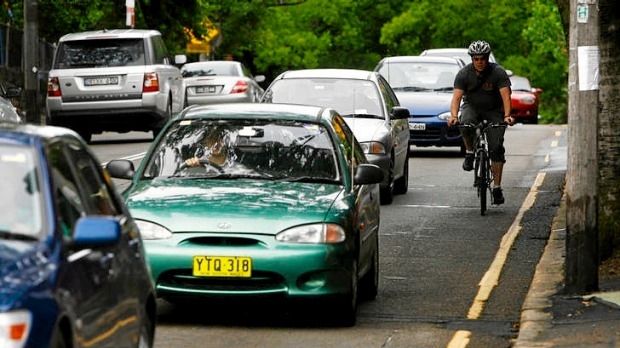
OK, but what about the fact that the typical cyclist is breathing harder as they pedal? In theory, differing levels of respiration will impact on the actual amount of pollution an individual takes in. Some studies showed a respiratory average of 2-3 times higher for cyclists compared with car drivers; this would put them no worse than on par with motorists. Increased travel time could also increase a cyclist’s exposure but (as has been demonstrated regularly in commuter challenges) in peak-hour traffic, cyclists generally don’t take any longer to get to their destination.
(Again, the growing prevalence of e-bikes is helping to reduce both riders’ respiration rates and travel times!)
In summary, cyclists (or would-be ones) can ride off with some comfort that they are not overly exposed to the various motor vehicle emissions – certainly compared with car occupants. By taking advantage of routes away from busy roads, and maybe even wearing a face mask, their exposure levels will be even lower. And of course they will be helping to reduce the pollution in the first place!
Do you feel comfortable riding around streets with combustion motor vehicles?
There’s a time-factor too – double the speed on the road, half the exposure? But you’re also breathing harder (at least, I am)